
A Pyramid that Sings: Did the Maya Engineer Sound, and Consciousness, at Chichén Itzá?
BY CLIFF DUNNING
Chichén Itzá is one of the most widely visited Maya archaeological sites in Mexico, famous for its remarkably preserved architecture, expansive ceremonial center, and easy access to many of its principal monuments. Yet beyond the temples, columns, its Great Ball Court, and towering pyramid of El Castillo, the ancient city possesses another, less visible distinction: its peculiar acoustic anomalies.
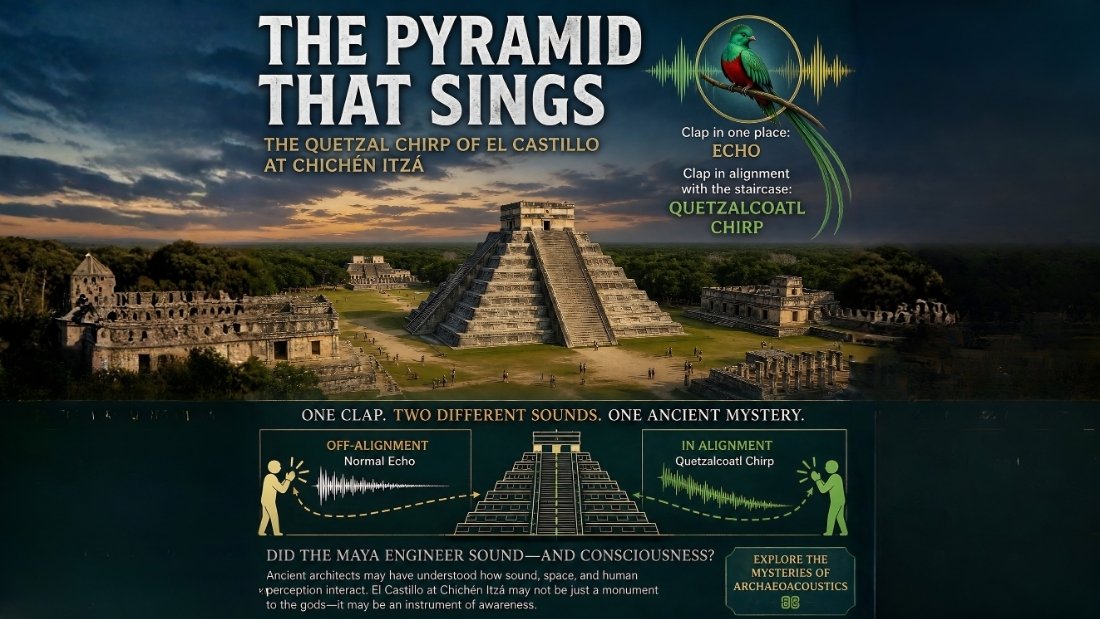
 I was introduced to this phenomenon over 20 years ago, when a tour guide positioned our group in front of El Castillo and asked us to listen carefully. He clapped his hands, producing an echo one might expect from a massive stone structure — a reverberation of sound that he created. Then he moved directly into alignment with the great staircase and clapped again, but this time the pyramid answered differently. The same sharp clapping sound interacted with the regularly spaced stone steps and returned as a short, descending chirp — remarkably like the call of the quetzal bird, an animal deeply embedded in Mesoamerican symbolism and associated with the feathered serpent.
The Chirp of El Castillo
The phenomenon has been known for decades and attracted the attention of acoustical researchers, most notably David Lubman and later Nico Declercq and his colleagues. In a peer-reviewed study published in the Journal of the Acoustical Society of America, Declercq’s team used mathematical modeling and computer simulations to investigate how El Castillo’s staircase transforms an impulsive sound such as a handclap. Their simulations demonstrated that the architecture itself produces the unusual frequency-changing echo. The chirp is real, it is measurable, and physics can explain how the pyramid produces it. What physics cannot yet tell us is why. Ordinarily, we think of an echo as a repetition. Shout toward a canyon wall and some version of your voice returns. At El Castillo, something more interesting occurs because the staircase acts upon the incoming sound. Its repetitive geometry causes different components of the sound to return at slightly different times, creating a rapid change in perceived pitch. Lubman originally emphasized diffraction associated with the periodic staircase, while later mathematical work showed that the process is more complicated than a simple reflection. For the visitor standing in front of the pyramid, however, the mathematics disappear. You clap, and the stone transforms the sound into something that resembles the call of a bird.A Bird Sacred to the Maya
That resemblance is what makes the phenomenon culturally intriguing. The quetzal was no ordinary bird in ancient Mesoamerica. Its brilliant green plumage carried enormous symbolic importance, and the bird was associated with power, sacredness, and elite authority. Even the peer-reviewed acoustic study acknowledges the cultural significance of the quetzal when considering whether the effect could have been intentional. The same research also points out that the feathered-serpent symbolism at Chichén Itzá provides an additional cultural context in which a quetzal-like echo is difficult to dismiss as completely meaningless.Footsteps, Rain, and the Great Ball Court
El Castillo presents another acoustic surprise as well. Researchers reported that footsteps higher on the staircase can be transformed acoustically for a listener positioned below. Instead of ordinary footfalls, the returning pulses can resemble raindrops falling into a container of water. Declercq and his colleagues specifically noted this phenomenon while analyzing the staircase. A pyramid associated with Kukulkan can therefore transform one sharp sound into something resembling a sacred bird call and another into something reminiscent of falling water. The level of architectural control required to produce such effects deserves more attention than it usually receives. We should be careful not to impose twenty-first-century acoustical engineering terminology on Maya builders, because there is no surviving Maya acoustics manual explaining diffraction, frequency response, or psychoacoustics. Yet we should also avoid the opposite mistake of assuming that ancient builders could manipulate sound only by accident. El Castillo demonstrates something fundamental: architectural geometry transforming sound predictably. The effect depends upon the dimensions and spacing of the steps, the geometry of the staircase, the position of the sound source and listener, and the physical characteristics of the surrounding surfaces. Modern researchers model these relationships mathematically, but the Maya did not need modern equations to recognize and work with them. El Castillo does not stand in acoustic isolation, either. Only a short distance away, the Great Ball Court presents another extraordinary sonic environment. Lubman’s work identified a pronounced flutter echo between its massive parallel walls and significant voice reinforcement within portions of the court. His presentations on Chichén Itzá emphasized that two major monuments at the same ceremonial center possess distinct and remarkable acoustic characteristics. At that point we are no longer discussing one entertaining echo — we are discussing architecture that repeatedly does unusual things to sound.Sound as an Architectural Material
The Maya built with limestone, plaster, proportion, direction, light, and shadow. Perhaps we should add sound to that list of architectural materials. Imagine Chichén Itzá not as it exists today, quiet and occupied by tourists, but as a functioning ceremonial city. Drums beat, conch trumpets sounded, whistles pierced the air, priests spoke from elevated positions, processions moved through plazas, and hundreds or even thousands of human voices may have chanted together. Place those sounds inside architecture capable of reflecting, reinforcing, redirecting, and transforming them, and the building itself becomes part of the performance — a tool to shift consciousness. A priest standing before El Castillo could produce a sharp sound and hear something resembling a bird answer from the pyramid. In the Great Ball Court, voices and impulsive sounds could behave in ways dramatically different from those in an open field. For people without a modern explanation of acoustic reflection, these events could have been extraordinary, but the important question is not whether the Maya lacked an explanation similar to ours. The important question is whether they understood the effect well enough to use it deliberately.Did the Maya Understand Consciousness?
This is where the field of archaeoacoustics begins moving beyond architecture and into human physiology. Modern neuroscience recognizes that repetitive sound, music, chanting, and rhythmic stimulation can influence attention, emotion, perception, and states of absorption. The human nervous system is not simply a passive microphone receiving acoustic information — sound is a physical stimulus processed by the brain and experienced throughout the body. That raises a more provocative question: did the Maya understand that sound could change consciousness? There are reasons to take the question seriously while stopping short of claiming that we have proved it. Maya ceremonial life involved music, chanting, dance, elaborate costumes, sacred architecture, fasting, bloodletting, and in some contexts psychoactive substances. These were powerful sensory environments rather than simple religious gatherings. If Maya ritual specialists understood that human perception could be intensified, redirected, or altered through combinations of sound, movement, architecture, and ceremonial practice, then acoustic design may have played a far more important role than we currently recognize. An Indigenous Maya perspective makes the consciousness question even more interesting. In Secrets of Mayan Science/Religion, Hunbatz Men discusses the Maya concept of ol, which he translates as consciousness, and connects it with awareness, attention, hearing, feeling, and the cultivation of heightened states. His broader interpretations are not conventional archaeological evidence, but they provide an important Indigenous intellectual perspective reminding us that consciousness is not exclusively a modern scientific concern. A hypothesis that I have developed is that Maya ritual specialists understood considerably more about the relationship between sound, architecture, and human perception than we presently credit them with. I am not suggesting that they possessed EEG machines or described brain activity in terms of alpha, theta, or gamma waves, nor can we currently demonstrate that El Castillo was deliberately constructed to alter consciousness. If a particular combination of architecture, voice, percussion, and rhythm reliably produced awe, focused attention, emotional intensity, or altered perception, that knowledge could become part of ceremonial architecture. The building would then serve not merely as the location of ritual, but as one of the mechanisms that helped produce the ritual state.An Unanswered Question
That is the larger mystery presented by El Castillo. The question is no longer whether the chirp exists, because acoustic science has answered that. Researchers have modeled the staircase and demonstrated how an ordinary impulsive sound can be transformed into the characteristic descending chirp. The unanswered question is intentionality. Was the resemblance to the quetzal accidental? Did Maya builders notice the effect and preserve it? Did they deliberately refine architectural dimensions to strengthen it, or was this one manifestation of a larger body of acoustic knowledge that we have only begun to recognize? Those questions can be tested. Researchers can compare staircases across Maya cities, reconstruct original plaster surfaces digitally, measure frequency responses, test reconstructed instruments and voices, and determine whether particular acoustic characteristics cluster around ceremonial architecture rather than appearing randomly. If no pattern emerges, the case for intentional acoustic design weakens. If comparable effects repeatedly appear in structures associated with ceremony, rulership, and sacred performance, however, we will have to consider a more challenging possibility: Maya architects may have been designing not only what people saw, but what they heard and felt. Perhaps monumental Maya architecture was simultaneously visual, astronomical, ceremonial, and acoustic. Perhaps the pyramid itself functioned as an instrument whose stone surfaces transformed the sounds of human activity into something emotionally and symbolically powerful. If so, the most sophisticated component of that instrument may not have been the building at all, but the human being standing within its field of sound.