
The Great Sphinx Colossus: A Hypothesis of Reconstruction
BY CLIFF DUNNING
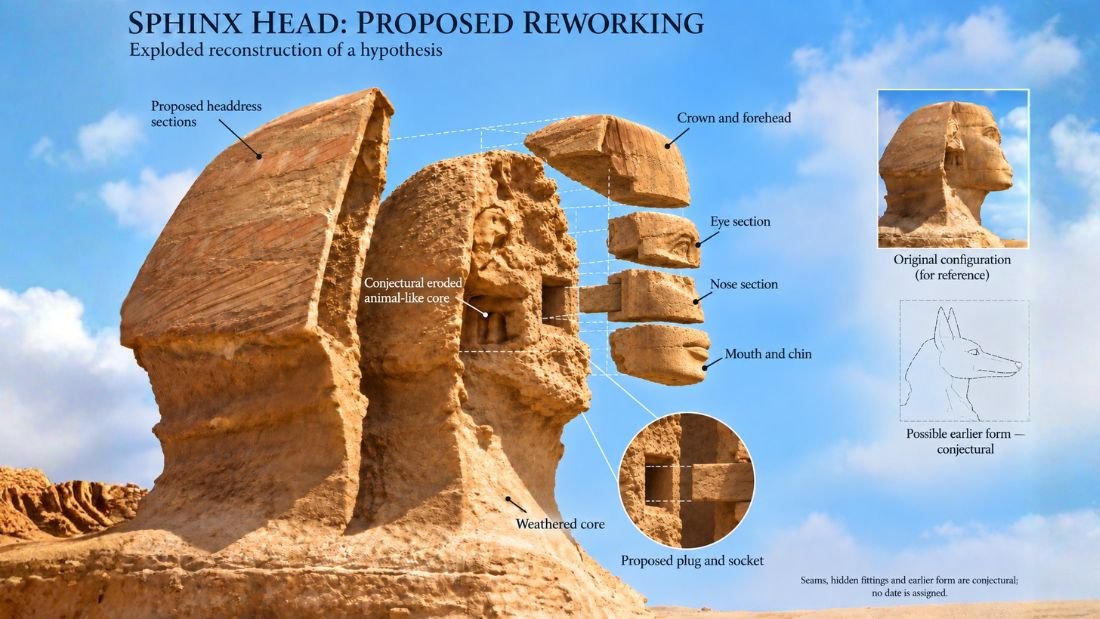
The familiar human face of the Great Sphinx may represent a later stage in the monument’s history. My hypothesis explores whether portions of its face and royal headdress were fashioned as separate stone sections and fitted over the reduced remains of an earlier sculptured head. The accompanying exploded illustration separates these proposed components, allowing us to consider how such an assembly might have worked. It is a construction hypothesis intended to generate questions that physical evidence can answer.
My starting point is the unusual feature beneath the Sphinx’s right ear. In photographs, this area appears to contain a recess and a projecting, roughly rectangular element. I interpret its appearance as a possible clue to a fitted connection, perhaps a plug, tenon, or attachment associated with an alteration. However, a photograph cannot establish the feature’s depth, composition, date, or purpose. A repair, a cutting made for another function, or the effects of damage must also be considered.
Lines visible across the head and face raise another question: do any represent boundaries between separate pieces? In this reconstruction, the forehead and upper headdress, the eye region, the nose, and the mouth and chin are explored as possible components fitted around a retained core. The ear remains associated with the rear portion. These divisions are proposed by the illustration; they have not been established as joints through direct examination. Fractures, bedding, erosion, and repairs offer alternative explanations for visible lines.
If such an arrangement existed, it would have required considerable planning. Each added section would need a bearing surface capable of supporting its weight, a means of maintaining alignment, and protection against movement. Projecting tenons, matching sockets, and fitted contact surfaces are possible mechanisms to investigate. Dowels alone should not be assumed to carry enormous loads. A credible reconstruction must explain how gravity, stone strength, and the geometry of the underlying head would keep the entire assembly stable.
The graphic includes a proposed connection behind the nose section. That concealed socket is conceptual, not a documented opening. Likewise, the weathered, animal-like core illustrates the possibility of an earlier sculptural identity, perhaps a jackal or another form. Its appearance is not evidence that such an animal head once existed. Establishing an earlier form would require identifiable remnants, structural relationships, or other evidence beyond the reconstruction itself.
The value of this hypothesis lies in the investigation it proposes. Historical photographs, detailed surveys, restoration records, and close inspection could help distinguish separate stone additions from continuous bedrock. Differences in stone composition, joint surfaces, tool marks, mortar, and concealed connections would be particularly useful. Equally important would be evidence contradicting the model, such as uninterrupted geological layers across the proposed boundaries.
The question is whether the Sphinx’s history includes substantial additive rebuilding of its head alongside erosion, repair, and possible recarving. Until the evidence establishes such a process, the exploded view should be understood as an invitation to examine the monument more closely: a visual proposal for how an older image might have been altered and given a new identity.